Acoustic design
|
Оформите заявку на сайте, мы свяжемся с вами в ближайшее время и ответим на все интересующие вопросы.
|
Заказать услугу
|
Acoustic Design (EU Standards)
What is acoustic design?
Acoustic design is a coordinated set of architectural, engineering, and operational measures that protects people from unwanted noise and creates a high-quality sonic environment in buildings and public spaces. Before any design starts, we review the architectural concept, room geometry and finishes, building services, and the site context (traffic, neighbouring uses, plant/equipment) to understand existing and potential noise sources.
European regulatory framework
Our work aligns with European and international standards and local building codes. Typical references include:
-
EN ISO 3382-1/-2/-3 — Reverberation and room-acoustic parameters (T20/T30, EDT, C50/C80, D50).
-
IEC 60268-16 — Speech Transmission Index (STI) for intelligibility.
-
EN ISO 16283 (parts 1–3) & ISO 717 — Field measurement and rating of airborne/impact sound insulation.
-
EN 12354 (parts 1–6) — Prediction of building acoustic performance from elements (flanking, façades, services).
-
EN ISO 1996 — Environmental noise (assessment of site/traffic/industrial noise).
-
EN 50849, EN 54-16/-24 — Sound systems for emergency purposes and voice alarm equipment (where applicable).
-
EU CPR (Regulation (EU) No 305/2011) — Construction Products Regulation (CE-marked acoustic products).
Country-specific rules (e.g., SIST/TSG in Slovenia) are applied at permitting and compliance stages.
What problems does acoustic design solve?
-
Compliance with legally required indoor and environmental noise limits and acoustic performance targets.
-
Protection of health and comfort (limits on LAeq/Lnight, control of reverberation and flutter echo, adequate STI for speech).
-
Reliable operation of AV/PA/VA systems and improved learning, working, and listening conditions.
-
Risk reduction: fewer post-handover complaints, delays, or retrofit costs.
Note: In Europe, acoustic compliance is verified against EN/ISO standards and local building regulations (not DBN/GOST or Russian supervisory bodies).
Typical deliverables
-
Performance brief with target metrics (e.g., T30/EDT bands, STI targets, R’w/DnT,w/L’nT,w, NR/NC/RC for background noise).
-
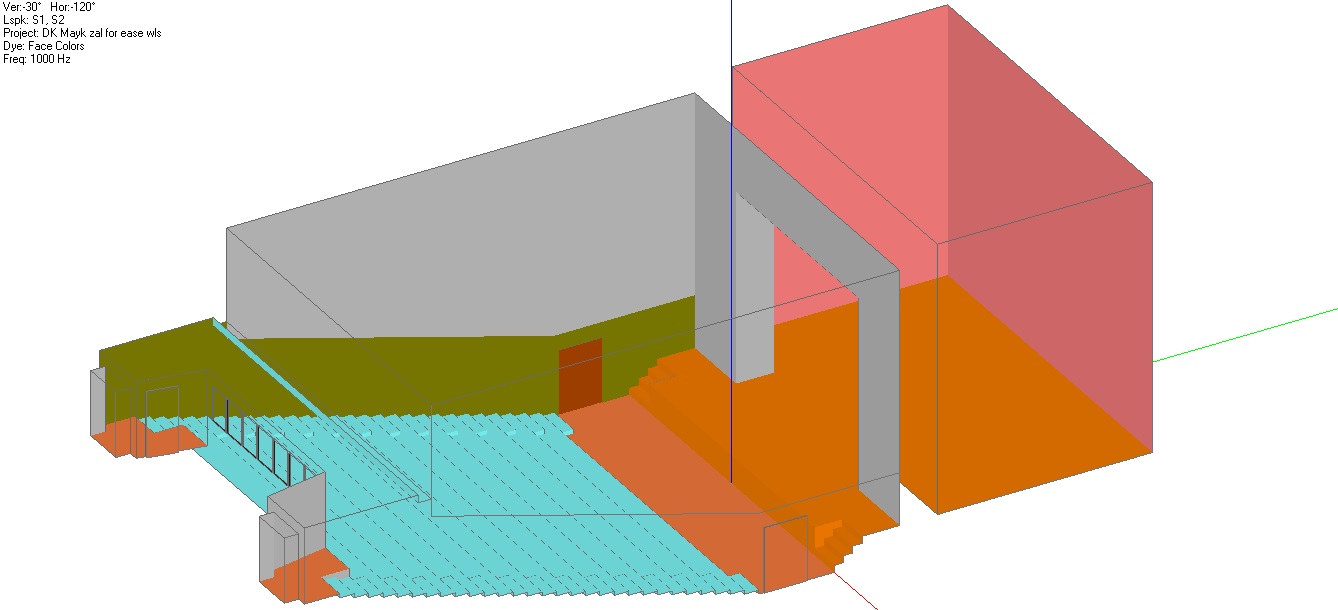
3D acoustic model (EASE/CATT/ODEON) and prediction reports.
-
Façade and partition design (EN 12354) with flanking control details.
-
HVAC/MEP noise control (silencers, vibration isolation, room criteria).
-
Material schedules (absorption/diffusion/isolating systems, CE-marked).
-
Construction inspections and commissioning plan.
-
As-built acoustic test report (EN ISO 16283, EN ISO 3382, IEC 60268-16).
Design stages (EU workflow)
-
Briefing & targets
Define use cases (speech, music, multipurpose), occupancy, background-noise criteria, and success metrics (RT, STI, insulation ratings). -
Baseline surveys
Site and building surveys: environmental noise (EN ISO 1996), existing services noise/vibration, geometry and finishes, potential flanking paths. -
Modelling & calculation
-
Room-acoustic optimisation (EN ISO 3382 parameters).
-
Sound insulation prediction (EN 12354) incl. façades and junctions.
-
Background-noise control from HVAC/MEP (selection of silencers/isolators).
-
Speech intelligibility prediction (IEC 60268-16, STI).
-
-
Design development
Detailing of wall/ceiling/floor build-ups, doors and glazing, resilient connections, penetrations, floating floors, acoustic ceilings, diffusers, bass control. Coordination with architecture, structure, and MEP. -
Documentation & specifications
Drawings, acoustic details, bill of quantities, product performance requirements (CE, DoP), installation guidance, commissioning tests. -
Construction support
Site reviews to verify workmanship (sealing, junction continuity, mechanical isolation) and prevent acoustic bridges. -
Testing & commissioning
Field measurements (EN ISO 16283, EN ISO 3382), STI verification, background-noise checks (NR/NC/RC), and an as-built Acoustic Report for handover.
Methods and typical issues we address
-
Reverberation control (T20/T30, EDT): balanced absorption and diffusion to avoid boominess or dullness; targeted low-frequency treatment for music spaces.
-
Speech intelligibility: STI optimisation via geometry, finishes, and electroacoustic design; control of early reflections and flutter echo.
-
Sound insulation & flanking: correct junctions, resilient mounts, mass-spring-mass systems, airtightness, and door/window specifications.
-
Building-services noise: fan/duct breakout, regenerated noise, structure-borne paths; silencers and vibration isolation.
-
Environmental noise: façade design (Rw+Ctr), ventilator selection, and site layouts that mitigate traffic/rail/plant noise.
Acoustic approaches in performance venues
-
Natural (unamplified) acoustics
For classical music/speech with precisely shaped geometry and variable absorption/diffusion to balance clarity and envelopment. -
Assisted/variable acoustics
Combination of natural acoustics with variable treatments (banners, retractable drapes, movable reflectors) and, where appropriate, electronic enhancement to adapt for speech, amplified events, or orchestral performance. -
Amplified/reinforced acoustics
Electroacoustic systems designed with room-acoustic control to deliver consistent coverage, tonality, and STI, including provisions for voice alarm compliance where required (EN 50849, EN 54-16/-24).
After design — what you receive
Upon completion, the client receives the approved Acoustic Design Package: performance brief, calculations and 3D predictions, detailed drawings and specifications, commissioning plan, and the as-built Acoustic Test Report demonstrating compliance with the relevant EN/ISO standards and local regulations.